WELCOME, TENANTS
Will SciFi
Rook Vale woke up next to a woman he was pretty sure was named Cass, in a motel that smelled like old smoke, on the last good morning the world would ever get.
He didn’t remember most of the night. That was normal. He was good at not remembering. It was the one thing he kept clean.
There was a gun on the nightstand, his. A bottle on the floor, hers. A gray light coming through the curtains that meant nothing yet.
Then every screen in the room went white. The TV. Both phones. The smoke alarm. The dead clock that had blinked 12:00 since before Rook stopped counting his sins.
A man appeared on all of them at once.
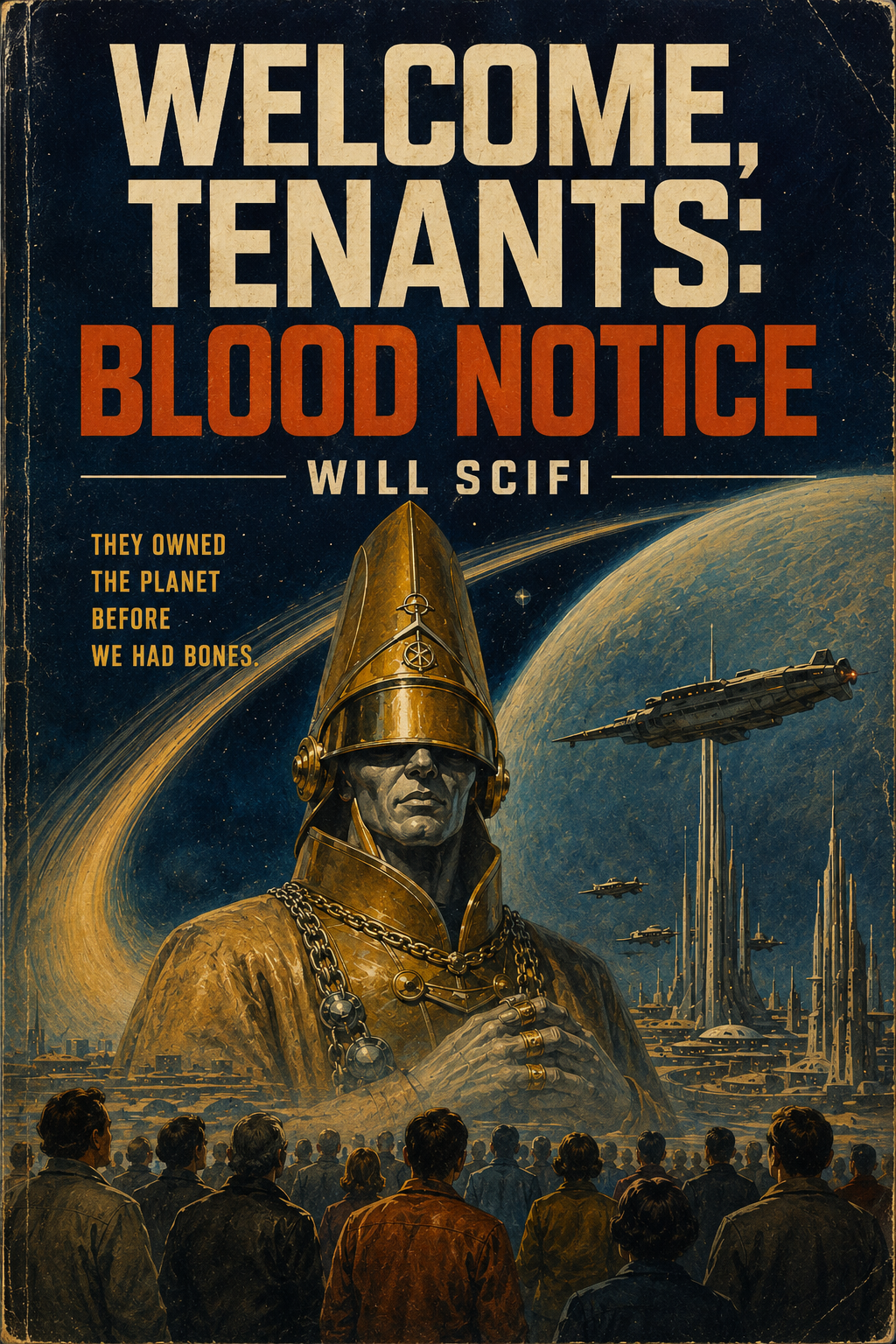
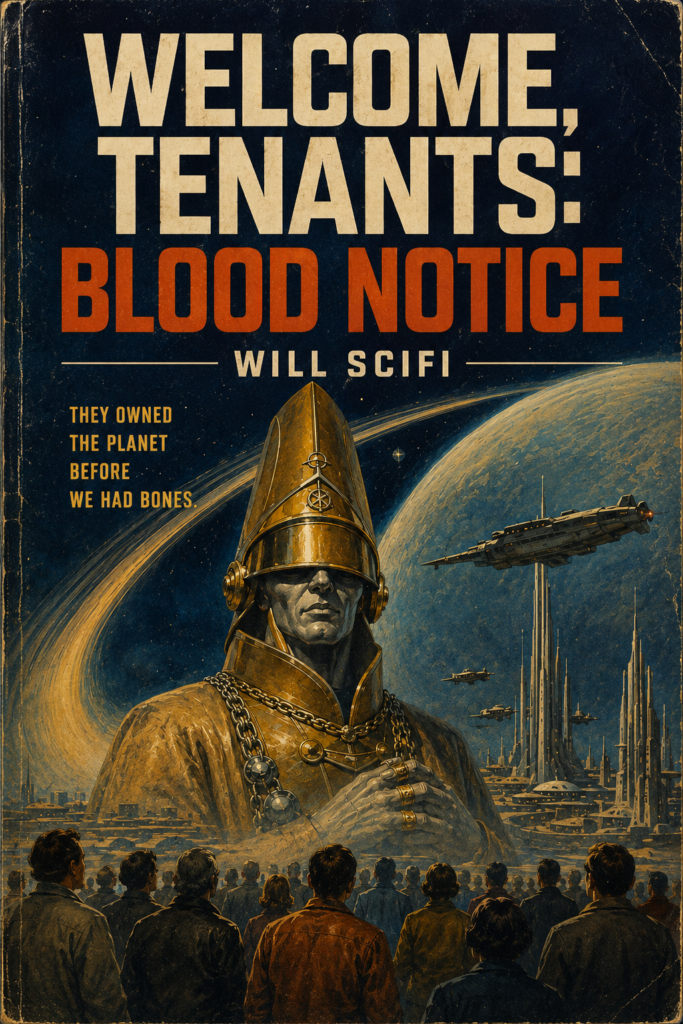
Gold robe. Silver chains. A tall hat like a church steeple. A polished gold visor where his eyes should be. His mouth had the tired shape of a man who had lost every argument for four billion years.
“Good evening,” he said. “We apologize for the delay.”
Cass sat up and grabbed Rook’s arm. He didn’t pull away. He just watched.
“Due to a stellar collapse, two civil wars, and a paperwork issue,” the man said, “our arrival has been delayed by four billion years.” He smiled like a funeral director upselling a coffin. “We are pleased to announce that we now claim legal ownership of Planet Earth. The oceans. The air. The soil. The dead. You.”
He held up a paper.
“This world was promised to the Continuance before your moon cooled. You are not owners. You are tenants. Your account is extremely overdue. Please remain calm during your inspection. Have a blessed day.”
The screens snapped back to a soap ad.
Cass said, “What the hell was that.”
“A landlord,” Rook said, and reached for his boots.
Then his phone buzzed in his hand. One message. From a number that had no business being alive.
DEX.
Rook’s chest went cold. Dex had been dead three days. Rook had watched two men put him in the ground himself, because he owed him that much and a lot more.
The message was set to send if Dex stopped breathing.
FIND THE DRIVE BEFORE THEY DO. STORAGE OFF 4. YOU OWE ME. DON’T BE A COWARD JUST THIS ONCE.
Rook read it twice. Then he stood up, put on his jacket, and left without saying goodbye, because that was the only kind of goodbye he knew how to do.
“Hey,” Cass called after him. “The world’s ending.”
“Yeah,” Rook said. “Got somewhere to be.”
* * *
Outside, the sky was filling up with gold.
They called the ships bells, later, the people who lived long enough to call them anything. Golden things the size of small mountains, hanging over the freeway, humming low like a church organ having a heart attack.
Rook had seen war. He had been paid for it on two continents. So he understood the thing that took everyone else an hour to learn.
This was not war. This was weather.
A fighter jet came screaming up the valley and fired at a bell. The missiles stopped a mile out, turned around, and flew back home. The jet became a flower of fire over the hills. Down the block, a man with a deer rifle put one round into a gold pod and the round came back through his eye before the sound caught up.
That was the only rule that mattered. The Continuance did not dodge. It returned things.
So Rook didn’t shoot at the sky. The sky wasn’t his problem. The drive was his problem. Dex was his problem, even dead.
He hot-wired a delivery truck while a collector folded a strip mall into a cube across the street. The building came down inward, not out. Brick and glass and a nail salon and the people inside it all crushed into one screaming ball the size of a bus. A drone slapped a gold sticker on it.
VACANT.
Rook didn’t look twice. He’d learned a long time ago that looking twice got you nothing but slower.
Storage Off 4 was eighty miles east, through a dying county, and everyone who knew Dex knew about the drive. That was the part that was going to hurt.
* * *
He was right about it hurting.
Three of them were waiting at the storage place when he got there at dusk. Men he’d worked with. Men he’d bled with. Roan stood in the middle with a shotgun and a smile that used to mean they were friends.
“Rook,” Roan said. “Knew you’d come. Dex always said you’d come for him. Never for anybody else, but for him.”
“The drive’s not yours.”
“It’s not anybody’s. It’s a meal ticket.” Roan spread his hands at the burning world. “Those gold bastards are buying. You hand them something that hurts ’em, you get to keep breathing. That’s the whole game now. Breathing.”
“So sell me out.”
“Already did. Step aside or don’t.”
Rook didn’t step aside.
The first man came fast and Rook broke his nose with the truck door, then his knee with a boot, then stopped thinking about him. The second got two hands on Rook’s throat and slammed him into a roll-up door hard enough to dent it. Rook felt a rib go. He felt the gray come up at the edges. He drove his thumb into the man’s eye until the hands let go, then put him down with a tire iron and didn’t check if he got up.
Roan fired. The buckshot tore a line across Rook’s left arm and lit it up like a road flare. Rook went down on one knee, vision swimming, blood already filling his sleeve.
He was not a hero. He wanted to be clear about that, even to himself. He was a tired man bleeding on cold concrete who simply refused, on principle, to be the one who died first.
He came up under the shotgun and shoved it skyward and they both heard it boom into nothing, and then Rook hit Roan in the throat, the gut, the throat again, ugly and close and final, and Roan folded against the storage door and slid down it leaving a long red smear.
“Dex,” Roan wheezed, “was the only one of us worth a damn.”
“Yeah,” Rook said. “He was.”
He cut the lock off unit 119 with bolt cutters that cost him every ounce of strength his arm had left. Inside, taped under a dead man’s workbench, was a hard drive the size of a deck of cards, wrapped in foil, with one word written on the tape in Dex’s ugly handwriting.
PROOF.
Rook didn’t know proof of what. He bound his arm with a shop rag, took the drive, and got back in the truck before he could feel all the things his body wanted him to feel.
* * *
The resistance found him before the aliens did. He almost preferred the aliens.
They ran him off the road at a dead gas station outside the valley, six of them in stolen gear, alien rifles made of bone and light, and a leader with a scar across one cheek and eyes that had already decided death was something you could negotiate with.
She put the rifle in his face through the broken window. “The drive. Now.”
“Everybody wants this thing,” Rook said. “Nobody’s told me what it is.”
She studied him. Bleeding, gray, half-dead, and still mouthing off. Something in her face shifted from kill to use.
“Imani Cross,” she said. “And it’s the only weapon left on this rock. Out of the truck.”
They patched his arm because a corpse couldn’t carry anything. In a back room that smelled like motor oil and fear, a kid with three laptops plugged in the drive and went pale.
“It’s their deed,” the kid whispered. “The claim. The thing they keep waving at us.” He looked up. “It’s fake. The signatures are forged. The original claim got sold off two empires ago. They don’t own Earth. They never did. They just showed up with a lie so old nobody alive could check it.”
The room went quiet. Outside, the sky pulsed gold.
“So we beat them,” someone said.
“No,” Imani said, and that was the moment Rook decided he could stand her. “We don’t beat them. You saw the jets. You saw the cubes. This doesn’t un-invade anybody. Earth is gone. We’re tenants now, all of us, whether we sign or not.”
“Then what’s it good for?” the kid said.
Imani looked at the foil-wrapped drive like it was a live grenade.
“It’s good for one thing. These things run on law. Claims and deeds and forms. It’s the only god they’ve got. You put proof of a fake deed into their own system, and you don’t free Earth.” She almost smiled. “You get them sued. By their own people. You start a war inside heaven’s filing cabinet.”
“Dex,” Rook said, mostly to himself. “You crazy bastard.”
Dex hadn’t been trying to save the world. Dex had never saved anything in his life. He’d been trying to make the people who killed him spend the next thousand years in court. It was the pettiest, most beautiful thing Rook had ever heard, and it was exactly like him.
“We file it,” Imani said. “There’s a Continuance intake center forty miles north. A sorting center. They’ve got terminals wired into their whole empire. We get a drive into one of those—”
“We,” Rook said.
“You,” she said, “if my people don’t make it. Somebody walks it in. Somebody plugs it in. Somebody probably doesn’t walk back out.”
Rook looked at the drive. At the word PROOF in a dead friend’s hand.
“Yeah,” he said. “Figured.”
* * *
They didn’t all make it. That was the math, and the math did not care.
A bell ship crossed the freeway as they drove north, and where its shadow fell, cars and trees and a whole little town named after a saint folded up into cubes, neat as sugar packets, and got stickered VACANT. The convoy lost two trucks to a collector that wasn’t even hunting them, just doing its job, the way a storm drowns a man without knowing his name.
That was the part Rook couldn’t shake. None of it was personal. The Continuance wasn’t cruel. It was worse than cruel. It was busy.
They hit a checkpoint that used to be human and was now something else. Rook took a knife in the side getting them through it, slid it out himself in the truck bed, and stuffed the wound with a stranger’s scarf. Imani watched him do it without flinching, which he respected, and didn’t offer to help, which he respected more.
“You always this much fun?” she said.
“Dying’s my best quality.”
“Why do it? You don’t care about the cause. I can see it on you. You’d let the whole planet get filed away and not lose sleep.”
“Probably.” Rook pressed the scarf harder and watched the gold sky roll by. “Dex pulled me out of a hole in Aleppo when leaving me would’ve been smarter. He covered for me when I ran out on people who deserved better. He was the one person I never managed to disappoint all the way, and I think it’s because he never let me close enough to do it.”
“So this is guilt.”
“This is a debt,” Rook said. “Guilt’s for people who plan to feel better. I just pay what I owe and move on.”
Imani looked at him a long moment. “You know you’re not getting out of that building.”
“I know.”
“And you’re still going in.”
“It’s the one thing I haven’t walked away from yet,” Rook said. “Figure I should see how it feels.”
* * *
The sorting center had been a stadium. Now the scoreboard glowed with a new motto.
WELCOME, TENANTS. FORM LINES BY VALUE.
LABOR. ENTERTAINMENT. LEADERSHIP. BIOLOGICAL SAMPLE. WASTE.
Nobody wanted waste, so waste had the shortest line.
A man in sunglasses reached a scanner and announced he could help them tokenize the planet. The scanner thought about it, then stamped him into a perfect screaming cube six inches wide, which a drone dropped in a bin marked DIFFICULT MATERIAL. The crowd got very quiet after that. Crowds learn.
Imani’s people hit the south gate to pull the collectors, and they died doing it, loud and on purpose, buying Rook a door. He went in through the smoke with the drive against his chest and a knife wound singing in his side, just one more tenant in a building full of them.
Inside, the bureaucracy hummed. Drones with stamps. Lines of crying people. And at a podium near the center, a small gold alien with a clipboard, processing the end of the world one form at a time.
Its collar named it Junior Deputy Compliance Apostle Vreeg.
Behind Vreeg stood a row of black terminals, wired straight up into the gold, glowing with writing older than language. Rook had found his filing cabinet.
He was forty feet away when the floor went cold and a shadow fell over the whole section.
High Steward Caldris stepped out of a beam of light. Seven feet of robe and rings, gold visor smooth as a coin. He did not look angry. The weather is never angry. He looked at Rook the way you look at a leak you have to deal with before lunch.
“Tenant,” Caldris said. “You are carrying stolen Continuance data. Surrender it for routine destruction. Resistance may result in late fees.”
* * *
Rook ran.
Not at Caldris. He wasn’t stupid, and he wasn’t a hero, and you do not punch a hurricane. He ran for the terminals.
A collector dropped from the rafters and landed between him and the row of black screens, fifteen feet of gold armor and horns, a tablet the size of a door. It raised one hand.
Rook didn’t shoot it. He’d learned. Instead he shot the gas main he’d clocked on the way in, low on the wall behind it, and the return rule did the rest. The blast didn’t hurt the collector. It didn’t need to. It just knocked Rook sideways through a service gap the explosion blew open, and he came up rolling on the far side, three feet from a terminal, both ears ringing, his side torn fully open now and bleeding bad enough that he knew the count.
He crawled the last three feet. The collector reached for him. Vreeg, oddly, did not.
Rook tore the foil off the drive and jammed it into the terminal’s port, which fit, because Dex had measured it, because Dex had planned this down to the millimeter while he was dying, the magnificent, petty son of a bitch.
The screen lit. Old writing scrolled. Then a single line, in a language the translator collars pushed into every human ear in the building at once, flat and bureaucratic and final:
OBJECTION FILED. CLAIM 88-THETA FLAGGED. AUDIT INITIATED. ALL PROCEEDINGS UNDER REVIEW.
The terminals went red. Then the next row. Then every gold screen in the stadium. Somewhere far above, in the bells, in the council chambers, in offices that had been waiting four billion years to collect, a number changed, and a lie that was older than bones got a case number.
Caldris went very still.
“What have you done,” he said. Not loud. Almost soft. The first human thing Rook had heard out of any of them.
“Filed a complaint,” Rook said, from the floor, in his own blood. “You people love those.”
Vreeg looked at the red terminal. Then at his clipboard. Then, very slowly, he made a note, because the form was valid, because rules were rules, and a properly filed objection could not be unfiled, not by a steward, not by a god, not by anyone. That was the whole point of having rules. Dex had bet his life on it.
“The objection is in order,” Vreeg said, to no one, to everyone. “It cannot be withdrawn.”
Caldris turned his gold visor down to Rook.
“You understand this changes nothing for your world,” he said. “Earth remains forfeit. Your species remains tenants. The eviction proceeds. You have saved no one.”
“Wasn’t trying to,” Rook said. “Just wanted to make sure you spend the next thousand years in court for it.”
And for one second, behind that smooth gold mask, the most powerful thing Rook had ever seen looked tired in a brand-new way. Not a landlord anymore. A defendant.
* * *
They did not kill Rook in a rage, because the weather does not rage. They processed him.
The collector lifted him off the bloody floor with one hand, scanned him, and a band of gold light wrapped his wrist. A drone stamped the air.
UNAUTHORIZED ACCESS. TENANT RECLASSIFIED. LABOR RELOCATION, OFF-WORLD.
“Figures,” Rook said. The room was going gray at the edges, and he wasn’t sure anymore if that was the blood or just the rest of it.
They carried him toward a beam of light with the same patience they’d carry a box. He didn’t fight it. There was nothing left to fight, and nowhere left to walk away to, and for the first time in his miserable, running life that felt almost like peace.
Earth still lost. He wanted to be honest about that, in whatever was left of his head. The bells stayed. The cubes stayed. Humanity signed the lease in blood and kept on breathing under new management, the way tenants do. The resistance kept losing in basements. Imani would fight a war she couldn’t win until something gold finally folded her up too. No one was coming. No one was saved.
But far above the burning blue marble, in a courtroom the size of a galaxy, a four-billion-year-old empire had just been served. An audit was crawling up the chain. Other claimants were waking up. The Continuance was going to spend the next thousand years explaining a forged signature to things even older and meaner than itself, and it was going to spend that whole time furious, and broke, and late.
Dex was square. The debt was paid. The one thing was done.
As the light took him, Rook Vale did the last free thing he had left. He laughed, blood and all, a tired ugly sound, because a dead man with a hard drive had reached up from the grave and slapped God with a lawsuit, and somehow that was the funniest thing that had ever happened to either of them.
“Welcome, tenants,” he said to the gold, and was gone.
The eye in the sky did not notice.
It was too busy reading the summons.